
General
Cozy Corners for Critters
By Sarah Vergara, Research Scientist
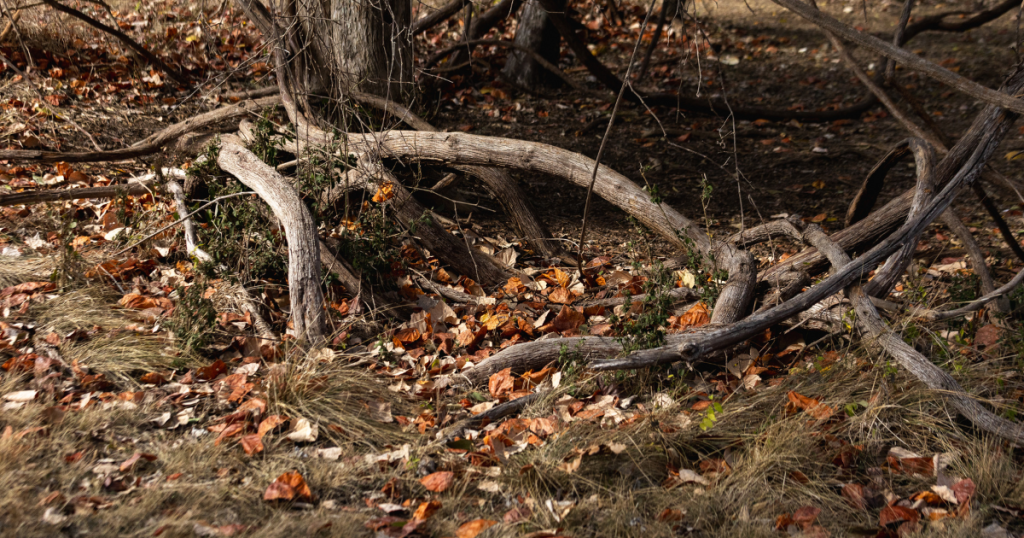
As we battle cedar pollen and the leftover holiday pathogens, it is that time of the year when we start thinking about leaves. Or maybe you’ve been thinking about them for a while…that tedious task where we brace ourselves for the incessant noise of a leaf blower and the repetitive task of leaf raking. This is your sign to leave the leaves for the pollinators! A leaf sanctuary is what I think of when I walk around the Cibolo Center for Conservation. We let things fall into place and let the leaves be. You may think they just fall and sit there, but these piles of leaves are vital habitat and cover for many crawling and leg-less critters. In the winter, butterflies, moths, fireflies, beetles, and bees lay their eggs under mountains of leaves. Everyone needs a place to rest and unwind from the busy seasons. Leaves are the top layer of a strong soil foundation, where healthy ecosystems thrive. When we rake, blow, and mow leaves, we are taking away important habitat and nutrient sources for soil microbes, plants, and other wildlife. So, leave the leaves! Or at least some…
Nature is all about energy transformations. The land you care for requires energy in various places. In an attempt to save energy that will be raked into bins and bags, one suggestion is to rake a leaf pile into a corner of the backyard landscape. Add some fencing to prevent winds from undoing the process. Another idea is to create “insect hotels” by using potted planters or an old bin and mix in leaves, ball moss, and space. Energy has been stored in the leaves in the form of carbon, nitrogen, phosphorus, and other micronutrients. This macro leaf layer eventually decomposes and forms micro leaf ‘duff’ and ‘humus’, a dark, nutrient rich organic matter layer aided by soil microbes and fungi. Energy is now stored in the ground, ready for new plants to uptake nutrients and repeat the process. Insects can take refuge in the warm, cozy leaf layers as they rest, reproduce, and begin the early stages of life.
Winter is the dark season, which is less productive but there are many treasures to be observed in the wild. Look up at the trees and you will find nests built from last year’s breeding season. Songbird nests mainly consist of natural products such as moss, lichen, twigs, and grasses. The more natural the better, so don’t forget to practice “leave no trace” when working or recreating on the trails. Now, look down at the ground and towards the rock piles. You may find insects, amphibians or small reptiles crawling and slithering around.
Rocks, rock for wildlife! Find some good rocks and create artistic, messy piles. Diversity is key. Use different rock types and sizes and keep the structure messy to create air spaces and access to the ground. The reptiles will thank you for the warm shelter during their winter brumation period. I like karst limestone since it is a natural feature of the Hill Country, and you can find some interesting fossils embedded in the rocks. You now have rock features that are both wildlife and water friendly to impress your family and friends. For extra credit, incorporate brush piles so that your landscape will be teeming with all types of wildlife. Pat yourself on the back, you are a land steward! Install game cameras to document which critters are using these habitats. Use e-bird and iNaturalist to record birds and other wildlife observations. Thanks for being a community scientist! These are some great ways to contribute to conservation and research. Let us know your results and come check out our corner of the world this winter at the Cibolo Center for Conservation!