
Birds
June Surprise on the Creek
By Craig Hensley, Naturalist and Educator

June’s arrival marks a lull in the calendars of birds and their chasers. Long gone are the chance encounters birders receive as migrants stream north from their tropical winter homes to temporary northern nesting grounds. A trip to the field now focuses on the local homebodies, our resident cardinals, mockingbirds, chickadees, wrens, and other species who are busily going about their parenting responsibilities, helping ensure a new generation of themselves.
Add increasing heat and many birdwatchers begin to focus on other pursuits be it butterflies, dragonflies or perhaps staying in the cool air of our homes catching up on a good book or two. There are those of us, however, who are so deeply infected with the birding bug that even the heat and the knowledge that each day’s eBird list will be nearly identical are not enough to keep us from looking, for there is always a possibility that a bird that should not be here might just show up. On Friday, June 6th, one of those possibilities presented itself–and the chase was on!
I am a birder who typically “sees” most of the birds I encounter by ear, that is, I hear them more than I see them, particularly when they are in dense vegetation. Just as one builds up an internal database of birds’ shapes, sizes and colors, a similar database is created for sound. Thus, when a song bursts forth that is beyond the typical database of songs for this area my brain goes into overdrive, reaching back to past files that have been collecting dust.
For this song the dust was thick enough that while I knew it was likely a warbler, only replaying several warbler suspect songs on my iBird app helped me access the file that said, “Yes–it is a Hooded Warbler (HOWA)!” I then pulled out the Merlin app, which helps identify bird song only to be disappointed as the app identified the song as anything but a Hooded Warbler – and that was likely because this species should not be in Boerne, Texas on any June 6th, let alone this one.
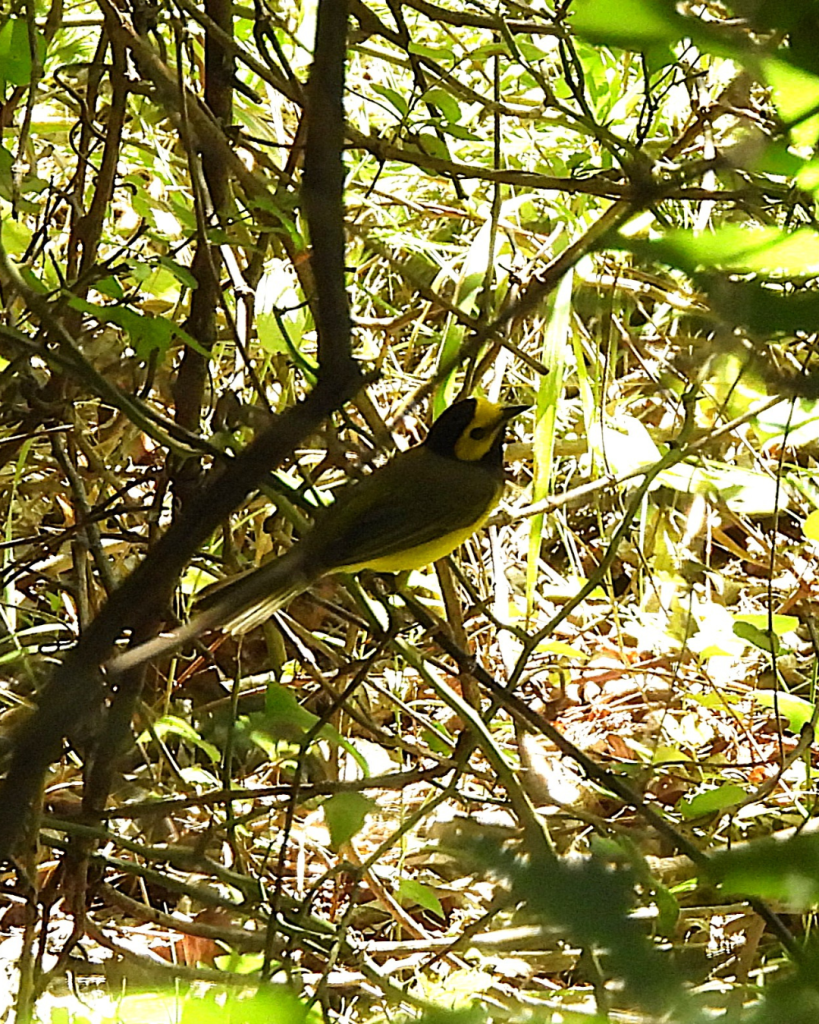
I documented it on eBird without a photo, and while it was recorded on Merlin, I had no other confirmation that it was a HOWA, as I was with a dog, not a camera. Within an hour I was back, with camera, sans dog. The bird was still singing but more infrequently, and as is its nature, laying eyes on this distinctive yet secretive bird was a challenge. Then, there it was! A glimpse of deep yellow with a black hood–and only a glimpse–because at that moment movement on the trail chased the bird down the hill. Augh.
Undaunted, I went home to regroup, did so, and returned to the center with binoculars, camera, water, a folding rocking chair and a good book. My final message to Terry was, “I don’t know when I will be back.” Knowing that the bird seemed to be singing in the same small area, I set up my chair in the shade, got comfortable, and told myself I would let the bird come to me, the opposite of what my birder brain would typically instruct. After half a chapter, the bird began singing again to my right in vegetation too thick to penetrate with camera or binoculars.
Patience, I told myself, and when it seemed that the sound was getting louder, I dared think this was going to play out just as I had hoped. Suddenly, movement at the bottom of the dry creek bed–the bird! In front of me, yes, but too far away through too many branches and leaves for a photo. Slowly the bird moved down the creek bed away from me, intermingling bouts of insect and spider hunting with singing. I scoped out the situation and my birding brain shouted “Go after it!” so loudly that I found myself stumbling down into the creek bed in a noise-filled clumsy human way. Thankfully, the bird continued to sing and forage–unfortunately, moving away from me.
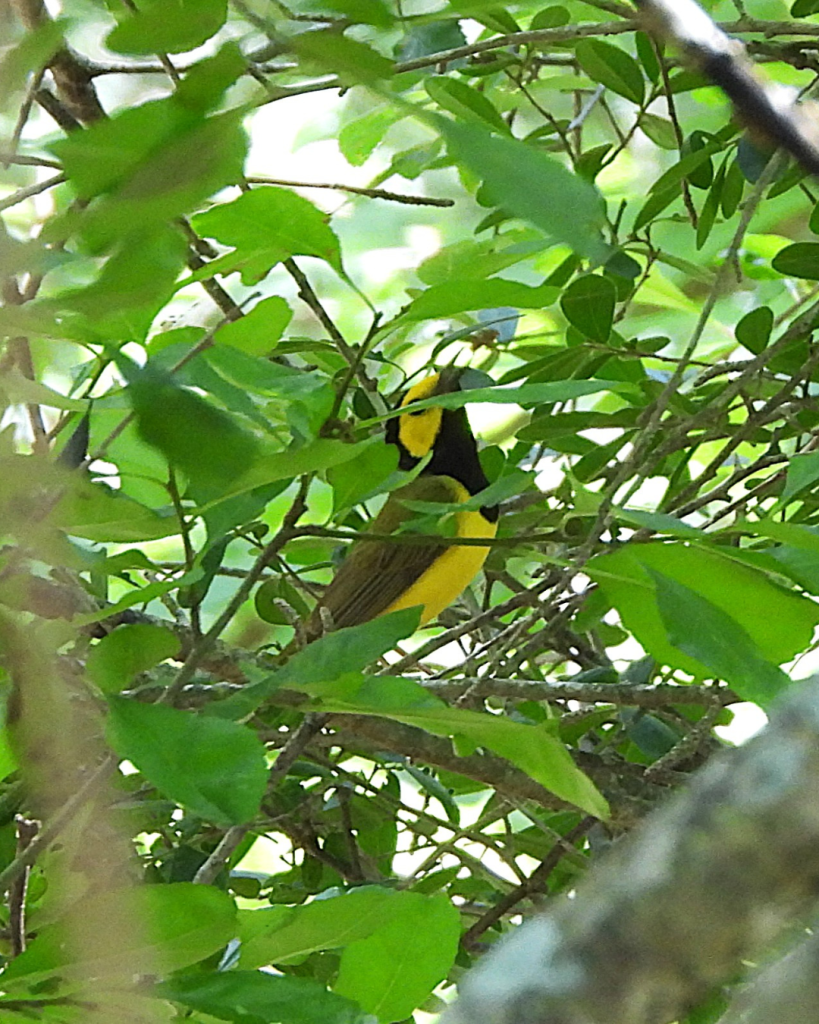
Finally, there it was again, on the ground foraging about 50 feet away. Camera up and a few blurry photos later I had it on film–in a digital sense, anyway. I kept following the bird as it ascended high into the cypress trees only to discover that it was doing exactly what I had originally hoped–making a circuit around its territory and heading back to where I had tried so hard to stay. With a quick retreat, I got back to my chair, mentally strapped myself to the seat, and waited. And waited. And then, he showed–this time close enough for decent pictures and great views through my binoculars. Success!
The Hooded Warbler is a gorgeous warbler with a distinctive black hood surrounding a deep yellow face. With an olive green back and yellow body, in the open it would be easy to see, but this is a bird of the underbrush. Intermingled with dappled sunlight sprinkled over varying hues of green leaves, it becomes as invisible in its typical east Texas haunts as it did here.
That this beauty showed up at The Cibolo was a real treat for me. However, just as happened last fall when another east Texas specialty, a Swainson’s Warbler, appeared on the creek for all of five minutes, what if I or some other birder had not happened along at the exact moment when it was singing, could it have gone completely unnoticed with no record of its existence to show for it? Maybe, and that is why I continue to go to the field, for even in June we never know what might be encountered.
Did I mention my first-of-year “PEE-o-WEE?” of the Eastern Wood-Pewee, the green flash and rattle of a speeding Green Kingfisher, or the spicebush swallowtail (butterfly) that posed for a photo that day, as well? See what I mean?