
Birds
Birds of New Zealand
By Ken Butler, Texas Master Naturalist

Prior to the arrival of humans, the islands of New Zealand contained no land mammals other than a few species of bats. As a result, birds dominated the animal ecology of the islands. Due the absence of terrestrial predators, some bird species evolved to becoming flightless and several species grew quite large in size and weight due to the plentiful food and mild climate.
The most notable of the flightless birds was the several species of Moa, the largest of which reached over 10 feet in height and could weigh several hundred pounds. The primary predator of the Moa was the Haast’s Eagle. It is the largest eagle known to have existed and its large size is viewed as an evolutionary response to the massive size of its Moa prey.
The Polynesian ancestors of New Zealand’s Maori people arrived on the islands in several waves of canoe voyages around 1300. The large, flightless Moa quickly became a primary food source for the arriving settlers. The Moa were hunted to extinction by 1400-1450. With the loss of its primary prey, the Haast’s Eagle also became extinct within the same timeframe.
The arrival of Europeans in the 18th century placed additional pressure on New Zealand native bird populations. The introduction of highly lethal ground predators, especially cats, stoats and weasels, was particularly impactful. The remaining species of flightless birds, which were unable to lay their eggs in elevated areas, were especially vulnerable.
New Zealand’s present day animal landscape is still dominated by birds. By international standards, New Zealand has a relatively small number of total bird species. However, what it lacks in total numbers, it makes up in uniqueness. New Zealand still possesses the world’s largest number of flightless bird species, including the world famous Kiwi. Roughly 25 percent of bird species found in New Zealand are endemic and found only on that island nation. As a result, New Zealand continues to be an important contributor to global bird diversity.
As with much of the rest of the world, New Zealand’s bird population continues to be under pressure. Flightless species continue to be in a state of decline and all are either threatened or endangered. In reaction, New Zealand has become a world leader in techniques to place endangered species on the road to recovery. One approach is to create fenced “ecological islands” from which predators have been eliminated.
One successful example of a fenced predator-free area is the Zealandia Sanctuary in New Zealand’s capital city of Wellington. The Zealandia ecosanctuary is over 500 acres in size and is surrounded by 5.4 mile long predator exclusion fence that is over 7 feet high.
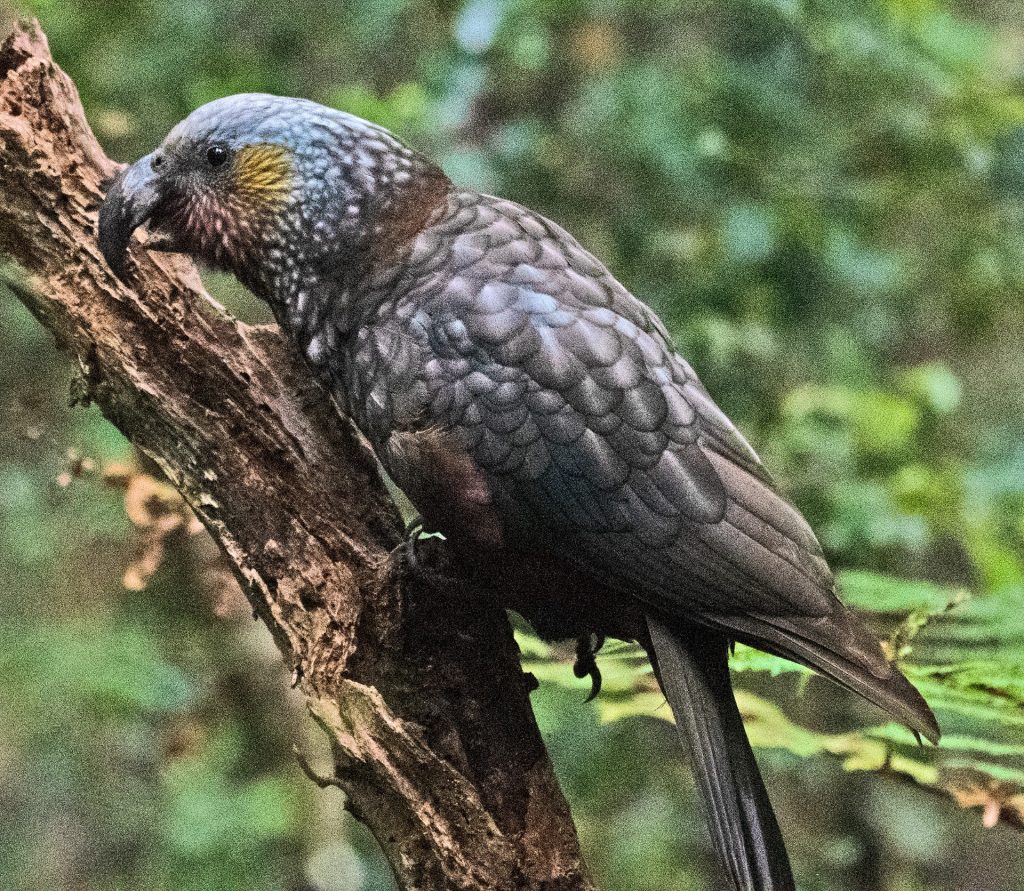
A number of endangered species have been introduced to the Zealandia Sanctuary and are slowly, but successfully, rebuilding their populations. An example is the Little Spotted Kiwi, the smallest of the Kiwi species. The population of this Kiwi was restricted to protected offshore islands, but has been successfully reintroduced to the mainland in the Zealandia sanctuary. Another very visible success story is the New Zealand Kaka, a native parrot. The Kaka has rapidly increased in population as a result of having a protected breeding area. The parrot is now frequently seen throughout the city of Wellington and is a “flying advertisement” for the value and success of the Sanctuary.