
Category
The Mouse Bird of Cibolo Creek
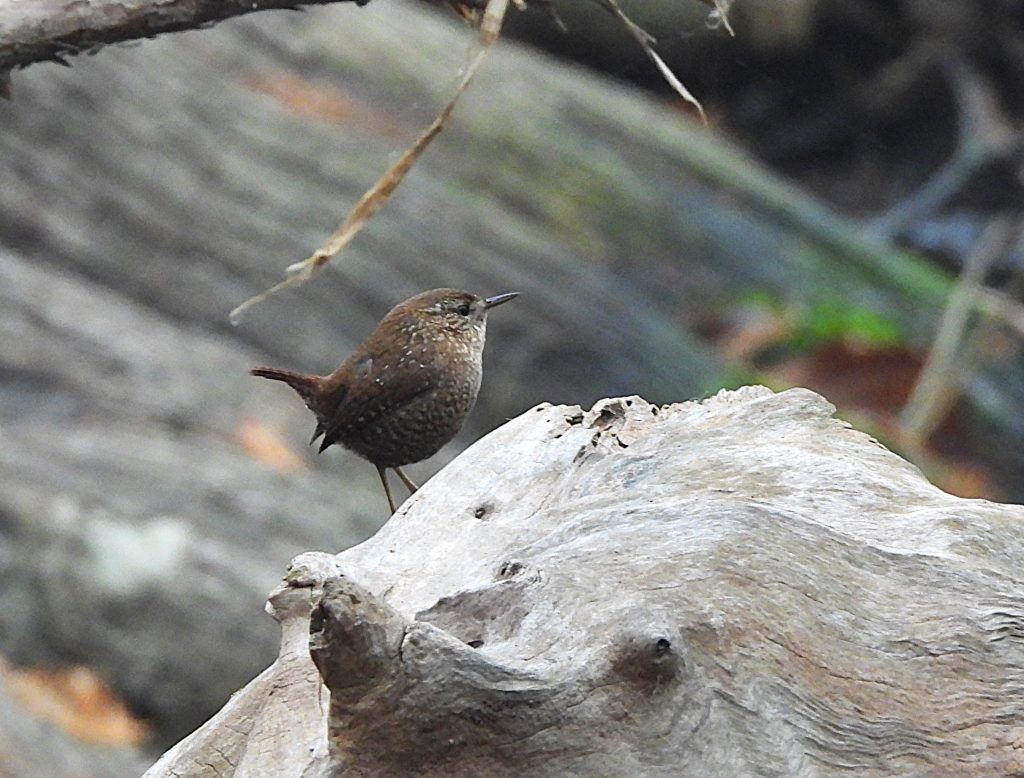
By Craig Hensley, Naturalist/Educator
Once again, just before sunset I have found the Barred Owl. This time, resting against a large cypress tree across the creek from me. As usually happens, my finding it was a combination of patience, persistence and the luck that comes from sitting on the right rock from which to conduct a methodical tree-to-tree search. But on this particular evening my luck was doubled, not from a second owl but from the surprising appearance, not twenty feet away, of the mouse bird of Cibolo Creek.
I typically begin my search for this four-inch chocolate ball of fluff in mid to late October. It arrives unknown and unseen by most, its winter world spent among the massive ribbon-like roots of bald cypress and in crevices of fallen branches and rocks searching for insects, spiders, millipedes and sowbugs. They are never here in large numbers, in fact the most I have ever seen in a day is two, and that was only a few days ago. And, according to my eBird list, I have only encountered it at the nature center 22 times since December of 2020. For comparison, I have turned in 22 checklists from the nature center just since November 17, 2024, as I write this.
Finding the mouse bird is a lot like finding my favorite nature center bird, the aforementioned Barred Owl. On any given day there is never a guarantee of success, and yet that is what keeps me searching for on those rare occasions when I do catch that twitch of fallen leaves or a sudden blur of movement along the creek’s bank, I feel a sense of elation – and confirmation that it is still there.
I can’t tell you which search is more challenging – finding a four-inch bird weighing in at a scarcely existent 0.3 ounces, or an owl standing 18 inches tall and weighing between one and two pounds. Both present their challenges and varying degrees of success.
The Winter Wren is the smallest wren in North America and one of the four smallest songbirds you will encounter in the winter at the nature center not called a hummingbird. The others include the equally diminutive Ruby and Golden-crowned Kinglets and the longer, but lighter weight Brown Creeper. And while those can be equally challenging, it is finding the mouse bird that thrills me most.
Winter Wrens spend their breeding season far north of Texas, raising their young in nests from northern Minnesota to Maine, north into Canada. On only one occasion have it seen it on its breeding grounds – at Morgan Meadows Wildlife Management Area in Maine. Because it doesn’t sing here, I relied on the Merlin Bird ID app to identify its beautiful song, described in one book as delivered “with remarkable vehemence” as if he was “trying to burst [his] lungs.” In fact, per unit weight, according to the Winter Wren account in Cornell Lab of Ornithology’s Birds of the World, it has ten times the sound power of a crowing rooster – at four inches in length, mind you!
Like its cousins, the Winter Wren raises its tail above its back like a flag. Unlike its cousins the more familiar Carolina and Bewick’s Wrens – both year-round residents of the Cibolo – and the overwintering House Wren, it has a stub of a tail, measuring barely more than an inch in length. Its overall plumage is a chocolate to cinnamon brown which provides excellent camouflage from would-be predators – and humans with binoculars.
According to my eBird records, they will be here until early April – my latest record being April 2. Over the next few months, as you walk along the creek below the woodland trail, don’t be surprised if you see an older man resting quietly on a rock, staring into the trees and among the fallen branches and roots lining the creek – that will be me, patiently watching for owls and wrens. I invite you to slow down, find a good rock of your own to perch upon and join the watch. Perhaps you too will see a blur of movement or the twitching of dead leaves, revealing the mouse bird going about its daily pursuits. And, if you are really lucky, you might even catch sight of a Barred Owl resting against the trunk of a tree. It could happen – it has for me.