
Category
Thorn Pigs of Cibolo
By Craig Hensley, Naturalist and Educator
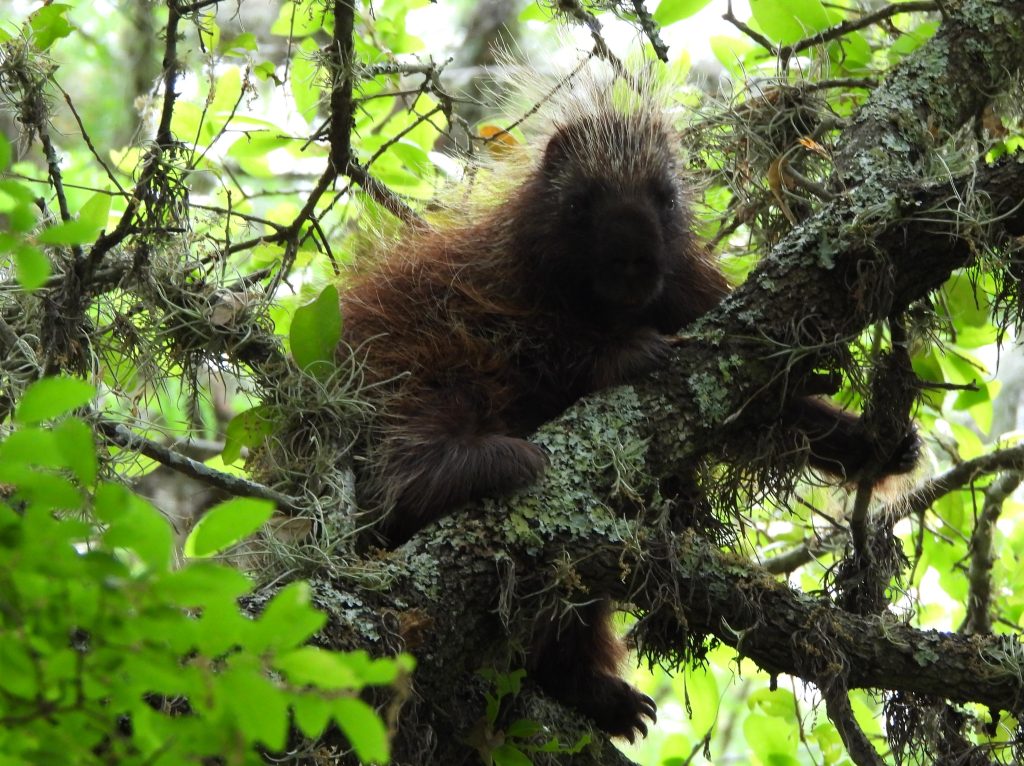
Every time I encounter one–the second largest rodent in Texas, it is memorable, from the first one I saw as a college freshman outside of Bottineau, ND in the dead of winter, it holding onto a treetop, me on the ground in 20 inches or more of snow to the one I encountered today, resting in a treetop along the woodland trail. Close encounters with this critter, unfortunately, can end badly, particularly for inquisitive pets in, as it turns out, both in life and death.
I say death because there was that time when I first moved to the Texas Hill Country and saw a road-killed North American porcupine. First, I was shocked because it never occurred to me that this animal could be in Texas; I thought for sure it was a northern critter of mountains and snow.
Immediately, however, that thought changed from the range as the only North American representative of the family Erethizontidae (don’t hurt yourself trying to pronounce that correctly) to collecting quills for educational purposes. Months later, long after its death, it would strike when one of the dogs I was sharing a home with at the time came out of my toolbox with a muzzle and tongue full of quills. It all ended well but let’s say that wasn’t a moment of marital bliss.
In life, the next one I saw was on a hot day in the Chihuahuan desert at the campus of Shumla School west of Del Rio. Again, I thought how in the world does this animal survive in a landscape fairly void of trees? Yet, there it was tucked under a boulder, taking advantage of the only shade for miles around that didn’t have something to do with a building. It turns out that porcupines feed, among other desert plants, on Ocotillo stems–a spiny treat for a spiny animal. There you go.
The most famous porcupine I saw was initially identified by my brilliant naturalist mind (I say facetiously) as a squirrel nest, until the nest came to life and turned its head to look at me. This was my first encounter at Cibolo Nature Center, and I say famous because when I shared my misidentification observation on social media, it was picked up by places as far away as North Carolina and Florida–I guess those outlooks were desperate for content back in halcyon days of COVID.
Of course, that wasn’t the only one that got its fifteen minutes of fame. As my wife Terry and I were setting up to call Barred Owls at the nature center a few years ago, one came crawling over a rock ledge to within a few feet. We excitedly began our Facebook live event a little early so folks could see it–it, not wanting the limelight, slowly turned around and disappeared.
My next encounter was along the prairie trail at The Cibolo on a lovely evening walk. Reminding me of Winnie the Pooh’s friend Eeyore, one was plodding along the trail in open grassland, not a tree in sight for a hundred yards or more. I say Eeyore because I always had the impression that walking for him was his least favorite activity; it always seems to me the plodding porcupine must be thinking the same thing. It turns out that during most of year, the primary diet of a porcupine is ground vegetation – and the prairie has plenty of that.
Now, back to today. “My” porcupine today was resting in the same oak tree on and off for a few weeks, displacing a roosting Barred Owl who previously claimed the tree for his own. It seems to find the live oak a good place for a nap, stretching out across its heavy branches some 15 feet or so up in the canopy.
You might wonder why I would be so enthralled with a rodent, and a rodent yielding a spiny punch if trifled with, at that. In over 50 years of wandering the wilds of Texas and beyond, I have had maybe a dozen encounters with this critter. That is not a lot so just like those of you who have had those rare (hopefully) encounters with a rattlesnake, each encounter leads to a memorable experience–and in the case of the snake, a no-doubt great story. Porcupines, rattlesnakes and other critters I don’t get to experience often keep alive my sense of wonder, my desire to get out into the natural world knowing there is the possibility of a chance encounter of the wild kind.
So, the next time you wander the trails of The Cibolo, be sure to look up once in a while for you never know when you will see a branch of dead leaves, no, wait a squirrel nest, no wait the thorn pig of Cibolo! Oh, by the way, they don’t throw their quills lest you still believe that old wives’ tale.